
Chapter Two
or, All Items Resolved

“Item one,” said the Contessa, settling into an administrative flow. “Establishment and maintenance of a functioning noble household meeting the land grant requirements—” She glanced up. “We can take this as read.”
“We can take most of it as read,” said the Conte. He rotated the whiskey glass in his hands.
“Item one,” she said again, “is resolved.”
She made a small mark.
“Item two.” She turned the page. “Solvency and sound management of the Casorio estates and associated holdings.”
Item two had been, in the first year, the entire point of the exercise. The estate had come to the Conte the way these things sometimes did — awarded to a soldier who had not expected to survive the war, let alone be granted a landed title at the end of it. He had known how to manage a campaign. He had not known how to manage accounts.
“Current status?” prompted the Contessa.
“Current status,” the Conte said, “is that we turned a profit for the third consecutive year.” His lips twitched into a smile. “I read Appendix C.”
The Contessa looked up.
“Finally,” she said.
“Four months is not an unreasonable—”
“It is absolutely—”
“I had other things to—”
“The appendix was two pages, Beltran.”
The Conte stopped rotating his glass. “The fields are very demanding.”
“In winter?”
The fire crackled in the hearth.
“Item two,” said the Conte, “is resolved.”
The Contessa looked at him for a moment, brow raised, then huffed a reluctant laugh. She made her mark.
“Item two,” she agreed, “is resolved.”
Item three — social obligations and establishment of the Conte’s position within the territory’s civic and noble structure — was also marked resolved (after a lengthy tangent regarding the Orvetti family and how they had finally stopped making snide remarks at gatherings).
Item four always took the longest. It covered the commercial arrangements for the Selvano Company’s newly established branch in the city, introductions to the noble network, and class-locked doors that the Contessa’s merchant family could never have accessed on their own. It was the most annotated section, with its own sub-appendix.
“The Casorio name,” she said, moving through the sub-clauses with a finger that paused at each one, “has been used in eight significant commercial introductions in five years. Six resulted in active trading relationships. One is pending. Another—” She glanced up. “—was the Moretti situation, which we don’t need to revisit.”
“No, we don’t,” the Conte agreed, with the feeling of a man who had sat through the original Moretti situation and found once to be one time too many.
“The branch is established. Staffed. Profitable within eighteen months of opening, which was ahead of projection. The Ferrante contract extends that by approximately—”
“Vessa.”
She looked up. He almost never used her name in the middle of business.
“We’re at item four,” she said.
“I know where we are.”
His expression was pleasant and composed — and expectant. This was the face he wore when he had decided something and was waiting to see if she had decided it, too. She had spent the better part of five years being mildly annoyed by how effective this expression was.
She looked back down at the document.
“Three more items,” said the Conte.
“Yes,” she said.
“And their status?”
The logs shifted in the hearth. Above them, the mantle clock ticked steadily.
“Resolved,” she said. “All three.”
“Vessa.”
“Beltran.”
“You know what I’m going to say.”
“I do,” she agreed with a twitch of her lips, “which is why I was very focused on item four.”
He made a sound that was almost a laugh.
She considered the contract anew, pen tapping against her thumb in time with the mantle clock.
“My family’s branch is established,” she said. “I have made inroads with the nobility. Your position is… secure. You don’t need me for any of it anymore. You can manage the estate yourself now.” She looked up. “You do manage it yourself, mostly.”
“Mostly,” he allowed.
“The Appendix C situation notwithstanding.”
“I read it eventually.”
“You did.” A flicker of a smile passed between them.
Her pen resumed its staccato.
“We have—” She stopped. She set the pen down with deliberate precision. “We have accomplished what we set out to do.”
“We have,” he said, gently.
The ice in his glass shifted, clinked.
Her gaze fell to the contract. His went to the southern windows. The grounds beyond had gone inscrutable in the dark, the fountain on the veranda only a vague silhouette.
He found himself staring at the reflection of the fire instead.
She straightened the pen next to the heavily annotated document. Her fingers lingered there.
“You want to find it,” she said. “The thing itself.”
His fingers flexed against his glass. “Is that—”
“It’s not stupid,” she interrupted. “Don’t ask if it’s stupid.”
“I wasn’t going to ask if it was stupid.”
“You were.”
“... I was.”
She huffed. Picked up her whiskey and held it without drinking. Her eyes slid to his face — the familiar lines of it, the scar along his jaw that caught the firelight.
“I know you, Beltran,” she said. “I’ve known from the start that you want—need—” A pause, something passing through her expression, then gone.
“It would be a waste for you to stay here, in something convenient, when you could have—” She gestured with her glass at something larger than this room, larger than the contract that lay between them.
He leaned forward slightly, elbows on knees.
“You’re making a very good argument,” he said quietly, “for something I notice you haven’t said you want.”
She looked at him fully. He met her gaze without flinching. He had never wavered under her sharp scrutiny. It was one of the more endearing things about him.
“I’m… comfortable,” she said finally, a quiet admission. “I have been—this has been good, what we built here. I want you to know that before I—before we declare it… done.”
“I know,” he said. “It has been. It is.” The whiskey glass turned in his hands. “If you asked me to renew I would, Vessa.”
She almost smiled.
“I could never submit myself to such suffering,” she said wryly. “You’d be very kind about it and then you’d spend the next year writing tragic poetry.”
This time, he did laugh, quiet and genuine and fond. “I don’t write tragic poetry.”
“But you do write poetry.”
“That is—I occasionally write—those are… observations. Sometimes in verse. For my own…” He sighed. “Yes.”
She chuckled.
His smile turned bittersweet.
The thing itself, she had said. The real thing.
They had never quite had that. They had skipped directly to the part where two people know each other well and care for each other honestly. It was true, and it was love — but the shape of the thing was different.
She looked at the contract — at the record of a thing done well. Done honestly. Done, now, completely.
She picked up the pen and made the final marks with a decisive hand. She closed the contract. Pressed her fingertips to the soft leather cover.
“It has been good,” he said into the quiet.
She met his eyes across the low table — across the whiskey decanter and the closed contract.
“Yes,” she said. “It has.”
They looked at each other for a long moment.
Then, the Contessa pulled a blank sheet from the back of the folio.
“The staff should hear it from us directly,” she said. “Before it goes anywhere else.”
“Agreed.”
“Tomorrow morning?”
“Yes.”
She wrote. He watched. The clock on the mantle measured the silence in small, untroubled increments, the way it always had, the way it would continue to do after all of this was different.
“Beltran.” She was still looking at the page, pen capped and set aside, her voice low, thoughtful. “When you find it—don’t overthink it.”
He was quiet for a moment.
“That’s very specific advice.”
“It’s very specifically for you.”
His expression turned slightly amused and painfully fond.
“Noted,” he said.
She picked up her whiskey. Drank. A moment later, so did he.
Neither of them watched as the ink dried on the page.
Chapter Three

The staff of Villa Casorio were, as a collective, discreet.
They were also human, which created a tension that the villa had managed, without incident, until now.
Image
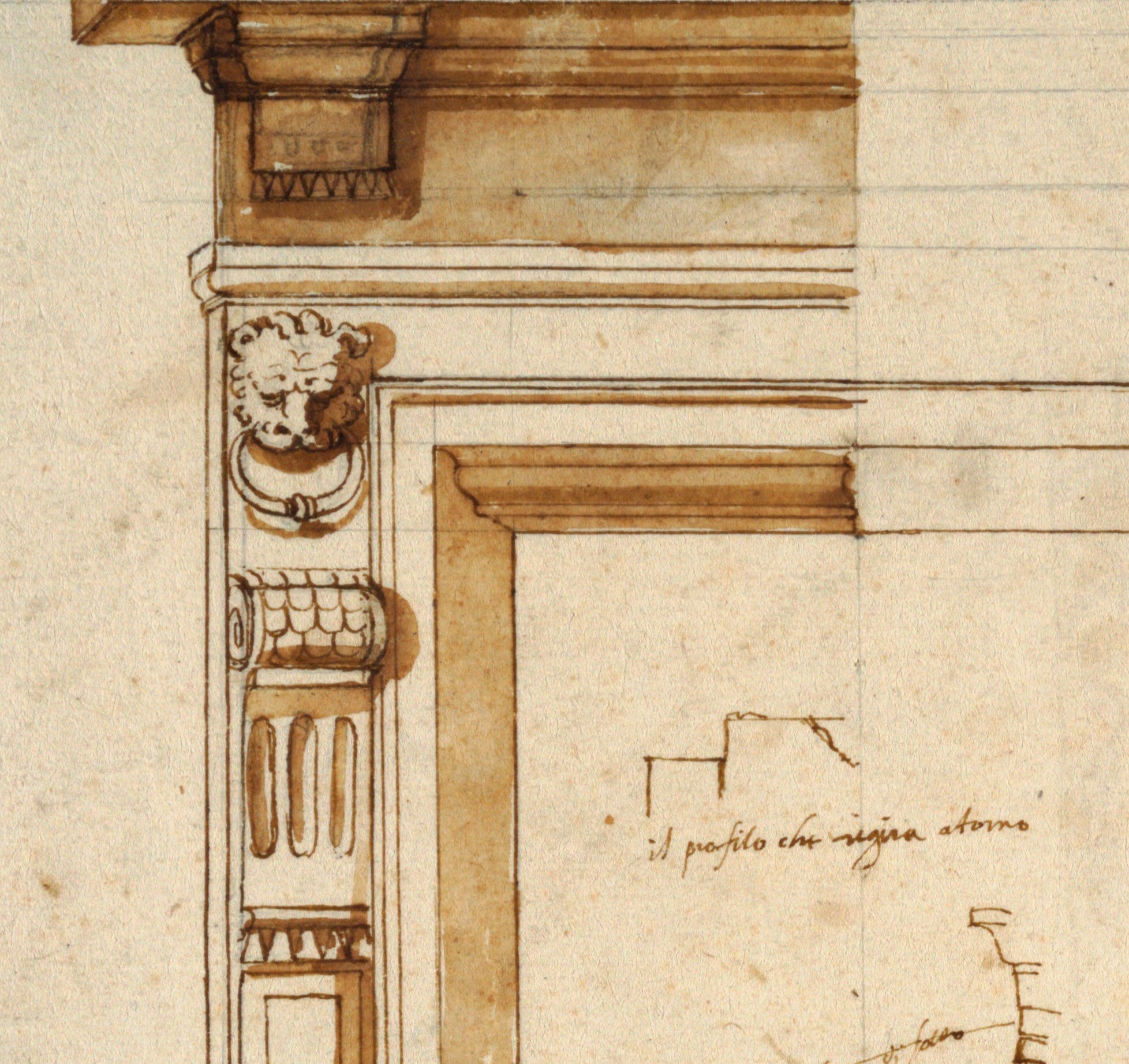
Follower of Michelangelo Buonarroti, Window for the Palazzo Farnese, Rome, c. 1575–1600 (public domain).
It is only getting better. Something is about to happen. And the dialogue was masterfully delivered. Not a single hint dropped, pretty much nothing happened, but it built a tenstion perfectly. A finish with some letter is a great clifhanger. Perfectly done.
The mystery deepens! I'm subscribing. :)