
Chapter Seven
or, The Dowager Marchesa Needs No Notice

The Dowager Marchesa Leonora of Roccastella did not write ahead.
This was not an oversight. She had considered writing and decided against it, for the same reason she had decided against waiting: her son would have told her he was fine, in the warm and slightly longer than necessary way he told people things, and she would have believed him provisionally, and she had found over the course of raising two sons that provisional belief was less useful than seeing for herself.
She arrived on a Wednesday, in the late morning, with one bag and her traveling companion and the serene self-possession of a woman who had never once in her life felt she required an invitation to visit her own son.
Signora Sera, who received her at the door, did not blink.
“The Dowager Marchesa,” she told the Contessa from the study doorway, “has arrived.”
The Contessa set down her pen.
“She didn’t write,” she said.
“No, my lady.”
A beat.
“Where is she?”
“The main receiving room. She asked for tea.” A pause that contained an entire paragraph. “She also asked whether you were in.”
The Contessa laughed quietly. “She knew very well I was in.”
“Yes, my lady.”
The Contessa looked at the letter she had been writing. At the correspondence box. At the day’s remaining work, which would keep.
“Tell her I’ll be down directly,” she said. “And tell the Conte.”
Leonora was not a tall woman, which had surprised people her entire life given the way she occupied a room.
She was in the main receiving room’s best chair when Vessa came in — whether by coincidence or by an unerring instinct for the best chair in any room — and she looked exactly as she always looked: composed, alert, dressed with dignified elegance. Her hair was silver and arranged without apology. Her eyes were her son’s eyes — the same amber, the same quality of attention, the same way of seeing things slightly before they announced themselves.
She stood when Vessa entered. She didn’t have to. She did it anyway, every time, because she had decided a long time ago that standing for people you respected cost nothing and meant something.
“My dear,” she said, and opened her arms.
Vessa, who was not generally a person who walked into open arms, walked into them.
This was the thing about Leonora that Vessa had not anticipated and had never fully gotten used to — the way her embrace felt like an argument you hadn’t known you were losing until you were already in it. Warm and certain and slightly too accurate, it was the hug of a woman who paid attention and remembered what she learned.
“You look well,” said the Dowager Marchesa, holding her at arm’s length with the assessing eye she had apparently passed to both her sons in different configurations.
“I am well,” said Vessa.
“Yes,” said the Dowager Marchesa. “I know.” She looked at her for a moment — not with wistfulness, not feigning acceptance, just looking at the truth of the situation and deciding what to do with it. “I came to see you before your move. And to see my son.” She sat back down, picked up her tea. “Sit.”
Vessa sat.
They were on their second cup when Beltran arrived.
He appeared in the doorway still in his outdoor clothes. He had come directly from the grounds without stopping to change, which meant he had come quickly, with something of the outdoors still warming his skin.
“Mama,” he said.
“Beltran,” said Leonora, in the tone of a woman who had been saying his name for thirty-odd years and had not yet tired of it.
He crossed the room and bent to kiss her cheek and she held his face in both hands for a moment in the way she always did — her thumbs finding the familiar architecture of it, the scar along his jaw, the shape she had known since before he knew it himself — and then she released him, and he straightened and pulled a chair close and sat.
For a moment all three of them were simply in the room together, in the ease of people who had learned each other’s company and found it good. Outside, the fountain on the veranda tutted in the direction of the breeze. Sunlight moved slowly across the floor.
Vessa watched Beltran watch his mother and felt an ache bloom in her chest, brief and clean. She picked up her tea.
At some point in the mid-afternoon, Beltran took his mother into the garden.
Vessa watched them from the study window, a glance that became a longer moment — the two of them walking the path between Matteo’s roses, Leonora’s hand in her son’s arm, their heads inclined toward each other, sharing things they wouldn’t share at the table.
Vessa went back to her correspondence and finished her response. She had a reasonable idea of what they were saying.
Beltran walked with his mother the way he had walked with her since childhood — matching her pace without thinking about it, the habit of not wanting to make her hurry.
He had known she would come. She had not written back — not a word, not an acknowledgment, nothing. His mother had always been more precise in what she didn’t say than most people were in what they did. A letter would have meant she was satisfied with distance. Silence meant she was already packing.
“She is well,” said Leonora.
“I know,” said Beltran.
“You know because you know, or because you have decided she is well and found it easier not to look too closely?”
“… The first one.”
“Good.” She walked. The roses submitted to her passage with Matteo’s distant supervision. “She did something remarkable here. You know that.”
“I do.”
“I’m not talking about the estate.” She looked at him sidelong. “You came back from that war different. Quieter. Harder to reach. And she reached you anyway.” A pause, thoughtful. “I suspect neither of you quite noticed when it happened.”
Beltran was quiet. The thing his mother was describing was true, and he had thought about it more than he’d admitted to anyone.
“She’s going to be alright,” he said. “I want you to know that. Whatever you’re worried about on her behalf, she’s going to be more than alright. The house on Via Serrano is exactly right for her.”
Leonora looked at him with the patient expression of a woman who had watched her son redirect conversations for decades.
“And you?”
He looked at the path ahead of them.
“I… I want the real thing,” he said. “I know it exists. I think I would know it.”
Leonora was quiet for a moment.
“It exists,” she said. Something moved across her face — not grief, nothing so present as grief, just the faint impression of something old and still. “With your father, it was—yes, it was real, and true.”
He pressed his hand over hers in the crook of his arm. They walked a few more paces before she spoke again.
“The real thing, as you put it, does not always announce itself the way the stories suggest.” She glanced at him. “Present company’s reading habits considered.”
“Says the one who instilled those habits,” he said with a small smile.
“Nonsense.” She waved her free hand dismissively. “Not instilled. Encouraged, perhaps.”
Encourage him she had, from the time he was a boy browsing her collection of poetry and classic love stories to the bundle of romance novels she had sent to the military hospital during his convalescence. He had consumed them privately, enthusiastically, and with some embarrassment.
The path took them past the pergola, where the wisteria vine had begun to flower. A wrought iron table and chairs sat in the shade.
Leonora stopped. Beltran waited.
“What I have come to ask,” she said, watching him closely, “is whether you have truly looked at what you have with her.”
“I have,” he said without hesitation. “I’ve looked at it more than anything in my life. It is good, and she is—extraordinary—but it—it’s not…”
Leonora’s brow furrowed as he trailed off.
“There was a time, early on,” she said, “when I was certain she—”
He stopped her with a sharp exhale, averting his gaze to the wisteria. His eyes dropped to the chairs beneath.
“I wish the answer were different,” he said, quietly.
She searched his face — the tightness of his mouth, the painful clarity in his eyes — and her expression shifted, a door quietly closed.
Her eyes returned to the two chairs beneath the pergola. She drew him gently from the spot.
“Then you know what you are looking for,” she said. She squeezed his arm firmly, the way she had when he was small and needed steadying. “You will recognize it. Trust that.”
Beltran said nothing, but his arm relaxed beneath her grip.
“Now, come,” said Leonora. “Show me what that gardener of yours has done with the winter roses. I want to see the canes.”
“Yes, Mama,” said Beltran.
She led him. He let her.
Leonora had a separate conversation with Vessa that evening, after dinner, in the southwest sitting room, while Beltran was occupied elsewhere.
The fire was good. The chairs were positioned correctly. Two wine glasses sat between them.
“I shall miss having you as a daughter-in-law,” Leonora said simply.
“I shall miss being one,” said Vessa.
“You will come to the winter gathering.”
“If I’m invited.”
“You are always invited,” the Dowager Marchesa declared. “That is not a thing that changes. Do you understand me?”
Vessa looked at her. “Yes,” she said. “I understand you.”
Leonora nodded, studying her face. “You look well, my dear,” she said for the second time that day.
The corner of Vessa’s mouth lifted. “I am well.”
“Are you?”
Vessa hesitated.
“Yes,” she said, after a moment. “I think so. I’ve looked at it honestly. It’s the right thing.” Her arm came to rest against her waist. “That doesn’t make it simple.”
“No,” said Leonora. “It doesn’t.”
Vessa looked at the fire.
“He will find it,” said Leonora.
“I know,” Vessa said.
Leonora looked at her and said nothing and drank her wine.
She left the following morning.
She embraced Vessa at the door with the same warmth and the same accuracy as the day before, and she held her son’s face in both hands one more time and looked at him in the way she had been looking at him his whole life — not checking for damage, exactly, just making sure of him, the way you made sure of something you loved.
Then she looked at them both standing together at the villa’s entrance in the morning light, and something in her expression settled.
She got into her carriage.
She was gone.
Beltran and Vessa stood at the entrance in the quiet she left behind.
“She told me to trust what I know,” said Beltran. “That I’ll recognize it.”
Vessa looked at the road, where the carriage had already rounded the bend. “Good advice.”
“You told me not to overthink it.”
“Also good advice.”
Beltran looked at her. “Between the two of you,” he said, “I’ve been very thoroughly counseled.”
Vessa’s mouth curved slightly. She kept her eyes on the road.
The morning continued around them, indifferent and ordinary, the way mornings did.
Chapter Eight

Varo processed the afternoon correspondence methodically, the small stack sorted by origin and urgency before he had fully settled into his chair. Bills of exchange. A letter from the northern holdings. Two invitations to things the Conte would decline.
Image
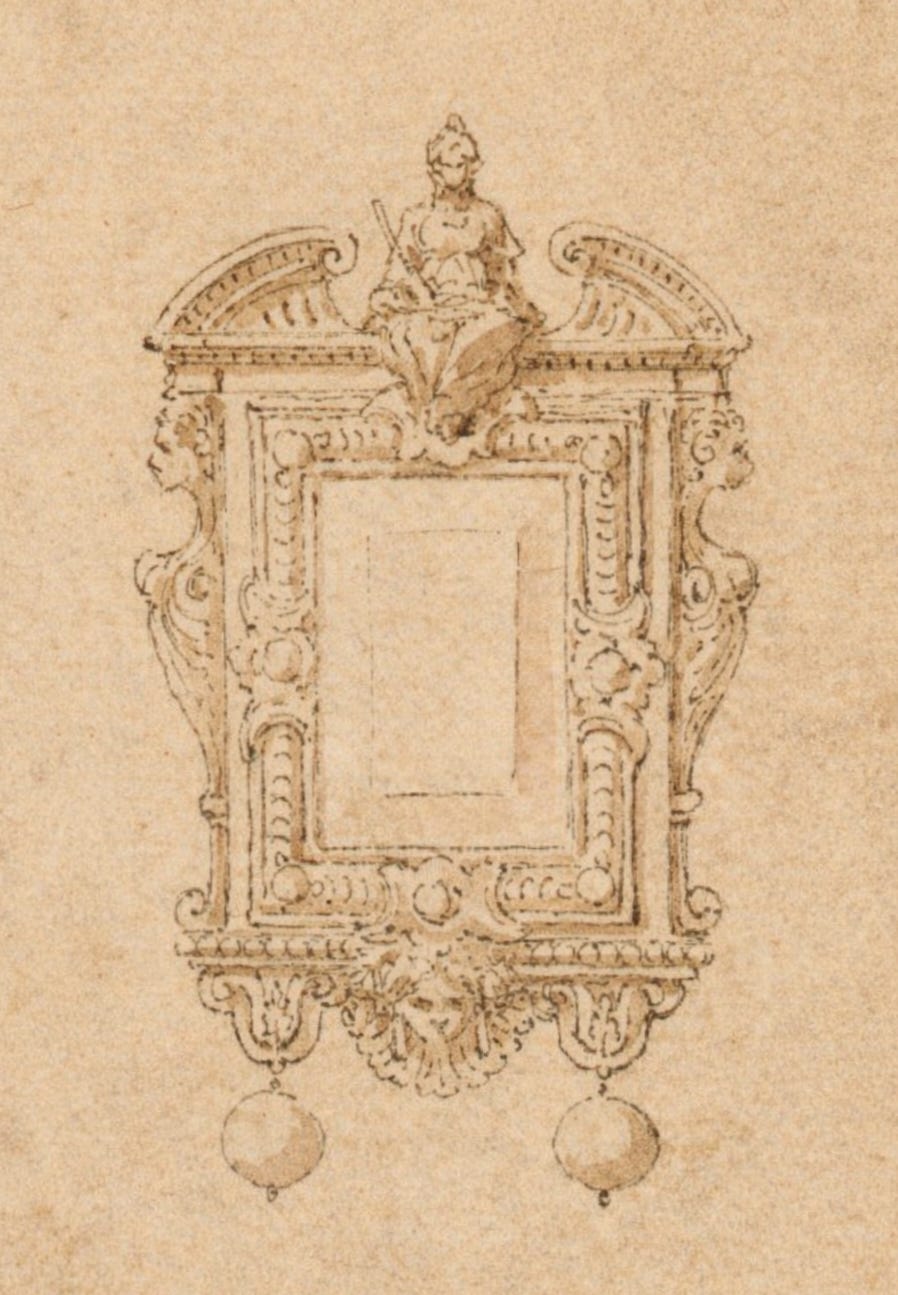
Design for Oblong Brooch, 16th century (public domain)