
Chapter Six
or, The Orvetti Gathering, as Observed by Someone Who Had Not Yet Formed an Opinion

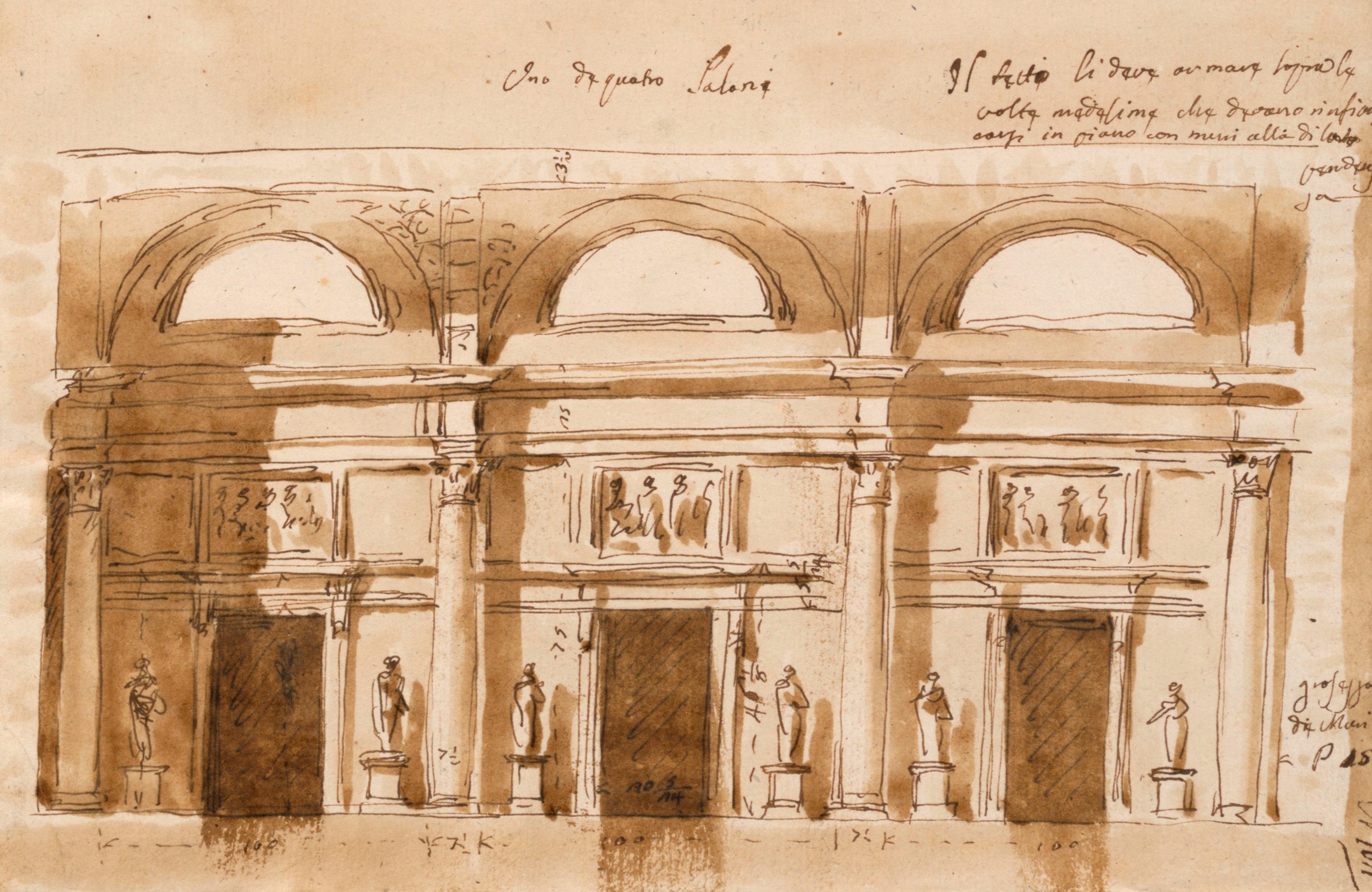
Villa Orvetti was, by any honest accounting, a great deal of villa.
It sat at Velleia’s most prominent address with the confidence of a building that had been the most prominent address for so long it had ceased to require justification. Six generations of Orvetti taste had accumulated on its facade in the form of columns — more columns than the structure required, arranged with the conviction that if one column made an argument, eight made it irrefutable. The stonework was excellent. The proportions of the original building, visible beneath the additions, were also excellent.
Someone, several centuries and several Orvettis ago, had understood something about how a house should sit on its land, how it should meet the eye, how it should hold itself against the sky. The subsequent Orvettis had built on this understanding with tremendous enthusiasm.
Inside, the same principle held: good architecture dressed in a great deal of everything. The receiving rooms were hung with tapestries that were individually fine and collectively overwhelming, like an argument conducted at full volume in a language you mostly spoke. The candelabras were silver and numerous. The flowers (early spring varieties from the province’s best gardens, many of which were owned by the Orvettis themselves) were arranged with professional precision in vessels that cost more than they needed to and looked excellent doing it.
The floor was pale stone, locally quarried, and in the evening light it glowed.
That part, at least, was simply beautiful and couldn’t be helped.
Adaeze Okafor had been in many houses.
She had seen compounds in the delta where the walls were thick against the heat and the inner courtyards breathed with the smell of rain-wet earth; receiving halls in trade cities where the ceilings were low and intimate and every surface told a story in carved wood; the rented palazzo here where the delegation from Malendi was staying: pleasant and slightly anonymous in the way of places designed to belong to everyone and therefore no one.
She took the measure of rooms the way she did cloth — reading the structure, feeling for tension, noting where things held and where they pulled.
The Orvetti receiving room pulled slightly to the left of the entrance, where the tapestries were hung too close together and crowded the eye. It breathed better toward the windows, where the evening light came through the western face and did something golden and unplanned to the pale stone floor. She positioned herself accordingly.
The people were dressed in the colors of the province: deep red, warm gold, the spring green of the hills she had seen from the carriage on the road north. Good cloth on the whole. She registered this automatically, the weaver’s assessment running beneath every other observation like an inner lining, and noted privately three instances of expensive fabric cut without understanding its weight, which made it hang wrong, which she found faintly painful in the way that only a weaver could.
Adaeze herself was wearing ochre, the warm yellow-gold of certain afternoons at home when the light came low and horizontal across the water and turned everything it touched into something worth looking at — and so it did here, warming the rich dark of her skin.
The garment was her own work, the pattern along the hem a design she had returned to for three years now; something about the embroidery felt productively unfinished.
The wrap at her head was the same cloth in a different weight, lined with golden thread and arranged that morning with her cousin’s considerable assistance and opinions. The gold needs to know your skin, Amadou had said, adjusting with his critical eye, it needs to sit against you like it was made there. He was usually right about these things.
She was visible in this room — taller, bigger, and brighter than most of the local women. She was an envoy of Malendi; it was her role to draw eyes, and she had learned to control what they saw.
The room filled with the gradual layered density of a formal gathering approaching its social peak — voices accumulating, the temperature rising slightly, the light shifting as the evening outside deepened and the candles became the primary source.
Adaeze moved through it with ease.
She spoke with a textile merchant who was extremely interested in her work and slightly too interested in her trade contacts, a distinction she managed pleasantly. She spoke with an elderly noblewoman who had opinions about foreign art that were wrong in interesting ways and right in accidental ones.
Signore Damiano, local attaché to the Malendan delegation, appeared at intervals with supplementary context, delivered in the manner of a man providing subtitles for a performance already in progress.
“The Conte and Contessa of Casorio,” Damiano said, at one such interval, “are expected this evening.”
“I heard,” said Adaeze.
She had heard considerably more than that. The delegation had been in the province for one week, and in one week the local gossip ecosystem (robust, well-maintained, and apparently delighted by a fresh audience) had delivered itself to her thoroughly. The housekeeper of their rented palazzo had been sympathetic to both parties and certain there was a great love story here that neither of them had yet recognized. Fiora Orvetti, encountered briefly at a civic reception two days ago, had been sympathetic to no one and had included the phrase I always said twice in four sentences.
What Adaeze had gathered, setting the interpretations aside: a contract marriage, recently concluded. Five years of a household that ran well and a couple nobody quite understood. A divorce pending civic acknowledgment, both parties apparently fine, which everyone agreed was the most suspicious thing about it.
She was curious.
She was in this state of mild and interested attention when the room changed. Not dramatically, but in the way a weave shifted when a new thread entered it — a slight adjustment of tension, the pattern reorganizing itself around something it hadn’t previously accounted for. She followed the adjustment to its source.
They came in together.
The woman first — genuinely small, perhaps two hands shorter than Adaeze and very slight. She was wearing deep slate: cool blue-grey against light skin, dark hair arranged without ornament around a small, sharp face, pale eyes that caught the candlelight sideways. The effect was precise without being studied.
The Conte she found a moment later. Tall, carrying his height the way soldiers sometimes did — without apparent awareness, the body habituated to being precisely where it needed to be. Olive-toned in the way of this region, with sun-burnished skin. A scar along his jaw, old and well-settled, the kind of mark that had become part of a face rather than an interruption of it. He was wearing deep green — the color of the hillside groves outside Velleia, which was either deliberate or the kind of accident that revealed something about a person.
He was not the most immediately striking man in the room. And yet he was the one her eye kept returning to, like an unfinished pattern.
Fiora Orvetti materialized at her elbow with the timing of a woman who had been watching for exactly this moment.
“The Conte and Contessa of Casorio,” she informed her, “have arrived.”
“So I see,” said Adaeze.
“The whole business is very—” Fiora lowered her voice to the register of someone sharing something confidential that they had already shared with everyone, “—remarkable. I always said, of course, that the arrangement was irregular.”
“What is she like?” asked Adaeze. “The Contessa.”
Fiora blinked, slightly wrong-footed by the direction of the question. “Formidable,” she said, after a moment, in the tone of someone reporting something faintly unsettling. “Exceedingly capable. She reorganized the entire Casorio estate management.” A brief adjustment. “The results were considerable.”
“And him?”
“The Conte?” Fiora’s expression shifted into something more straightforwardly approving. “Good man. Decent. Pleasant company.” She paused, as though expecting to have more to say, and found she didn’t. “Pleasant company,” she said again, slightly deflated by the blandness of it.
Adaeze watched the Contessa moving through the room with an appraising gaze, receiving greetings with the precision of someone who had learned this choreography and performed it without effort. The Conte stood slightly behind and to her left — habit, or courtesy, or both — speaking to someone with a pleasant, composed expression.
She thought about thread. About the way two threads running parallel in a weave were neither touching nor separate — held in relationship by the structure around them, each one defining the other’s position, the tension between them part of what made the whole thing hold.
The gossip has the shape of the thing, she thought, but not the texture.
Fiora was still talking. Adaeze received it with the attention it merited.
The evening continued. Adaeze spoke with a guild master about the dye trade in the province, which was genuinely useful, and with a young noblewoman who had strong and well-founded opinions about the inadequacy of most available silk thread. She found herself near the windows at one point, where the stone floor still held its warmth and the view over the dark gardens showed early spring doing its tentative work.
She was deep in conversation with a wool merchant’s wife about natural dye fixation in humid climates — the best kind of diplomatic work, the kind that didn’t feel like any — when she noticed Fiora Orvetti position herself at the far end of the room in conversation with the Contessa.
The Contessa was listening — the angle of her attention steady and direct, receiving whatever Fiora was saying with an even, lightly amused expression.
Then — briefly — the Contessa’s eyes moved. A small shift, a quarter-turn of attention, finding something across the room.
Finding the Conte.
Who was already looking.
It lasted two seconds. Perhaps less. The Conte’s expression didn’t change in any way Adaeze could have named precisely, but something in it settled, or confirmed, or simply acknowledged. And the Contessa: the corner of her mouth, the right side, moved. Not a smile. The implication of one, the ghost of the intention, there and gone before it had committed to existing.
The Conte caught it.
Something in him — in the set of his shoulders — shifted just slightly. Then the Contessa’s attention returned to Fiora, smooth and uninterrupted, and the Conte turned back to his own conversation, and anyone who had not been watching at exactly that moment would have seen nothing at all.
Adaeze had been watching at exactly that moment.
She held the observation up to the light of everything else she’d gathered. The varying versions of the story. Fiora’s careful blandness when describing him. The geometry of how they moved in the same space.
She thought: There is the texture.
Then the wool merchant’s wife said something about indigo fixation that was technically incorrect in an interesting way, and Adaeze let the thought settle and the evening carry her forward.
The gathering concluded in a gradual dispersal, the warmth of the room cooling as people found their carriages, the Orvettis seeing their guests out with evident satisfaction — hosts who had put on an excellent production and knew it.
Adaeze was collecting her shawl when she became aware of the Conte and Contessa nearby, also departing, exchanging their final pleasantries of the evening as a pair for, apparently, the final time.
She did not intend to catch his eye. She was thinking about the evening, about the texture of the province and its people, about the tapestry third from the left which she had been mentally revising for an hour.
He glanced across the space — the natural survey of a man gathering himself to leave.
Their eyes met.
A moment. Brief, unremarkable, the ordinary kind of exchange that happened a dozen times at every gathering. He inclined his head, slightly, in the territory’s gesture of acknowledgment. She returned it.
His eyes were the color of saffron dye. Not on the first steep. The second, where bright yellow deepens to gold.
Adaeze noted this the way she noted a color she might want to use later — and then he looked away, and she looked away, and the Contessa said something quiet to him as they turned to go, and he answered in the easy shorthand of people for whom the other’s language had long since become their own.
Adaeze stepped out into the night, where the spring air was cool and clean after the warmth of the Orvetti candles, and the stars above Velleia were the same stars that shone at home across the sea.
She was, she decided, going to find this city very interesting.
The gold caught the starlight as she moved.

Chapter Change Log
5/5/26
Specified “the city” as Velleia
Image
Giuseppe Barberi, Design for Salon Entrance Wall, 1746–1809 (public domain)
I love the recurring use of the textile metaphor for the Conte and Contessa's presence and actions at the Orvetti Gathering, coupled with textiles as the focus on the business/social discussions. Well done!