
Chapter Five
or, Nico Selvano, in Several Movements

Five days later, Niccolo Selvano arrived.
He did not write ahead. He did not send word. He had come from Altina with two bags, a friend nobody had invited, and a great deal of energy.
“I’m here for Vessa,” he announced to Signora Sera at the door.
The Signora looked at the two bags. At the uninvited friend. At Niccolo — Nico — himself, who was wearing something that the capital’s tailors had produced and which fit him extremely well.
“Of course,” she said. “I’ll have the guest rooms prepared.”
“Rooms, plural, yes, thank you, Signora, you’re wonderful—” He was already past her, into the main hall, head turning with quick, comprehensive energy as he took inventory of the space. “It smells the same. Does it smell the same to you, Dario?”
“I couldn’t say,” said Dario, who had never been here before.
“It smells the same.” Nico looked up at the ceiling, at the familiar proportions of the hall. To the Signora: “Where is everyone?”
“The Contessa is in her study. The Conte is—”
“I’ll find them.” He was already moving. “Dario, the bags? Thank you. Signora, the rooms? Wonderful—” And he was gone, up the stairs, his voice trailing behind him like a flag.
The Signora looked at Dario.
Dario looked at the bags.
“I’ll take those,” said the Signora.
Vessa heard him before she saw him — brisk, familiar footsteps that were not trying to be quiet and had never learned how — and had set down her pen by the time the door opened.
He swept in, crossed the room in four strides, and hugged her hard, the way he had hugged her since they were children, without asking and without apology.
She let him.
Varo, who had been at the side desk with the correspondence, gathered his documents as though he had somewhere else to be. The door closed behind him with the tact of a well-managed exit.
Nico released her, but kept his hands on her shoulders. He looked at her with their father’s eyes in his face — warmer, quicker, less patient with conclusions.
“Good,” he said. “You look like yourself.”
“I am myself.”
“Some people aren’t, after—” He made a vague gesture encompassing the general category of significant life events.
“I know.” She studied him for a moment. “Sit down, Nico.”
He sat. This was a reflex. Vessa said sit and you sat.
She took the chair across from him and folded her hands on the desk.
“Go on,” she said.
“I haven’t said anything.”
“You’ve been not-saying it since you walked in.”
He looked at her desk. At the papers on it, the correspondence box, the pen set down at the precise angle she always left it. At the afternoon light spilling across her face, and the window, and the grounds beyond where everything was — the same.
The roses. The fountain. The pergola where they had—
“Why can’t you just stay together?” he said suddenly. It came out smaller than he intended.
Vessa waited.
“You’re good together—” Now that he’d started, he couldn’t quite stop. The words came with the momentum of things that had been held in. “—and you work. The house works, everything works, you—you like each other, you make each other better. This is good, Vessa, genuinely good, and I don’t understand why good isn’t—why that isn’t enough, why you can’t just—”
“Nico.”
“—stay. Just stay. It doesn’t have to be—it doesn’t have to be some grand—you love each other, anyone can see that you—”
“Nico,” she said again, gentler.
He stopped.
She was looking at him with an expression that was not unkind and was not soft and was entirely her.
“We do love each other,” she said. “That’s true. It will always be true.”
A pause. Considered.
“We are not in love with each other. That is also true.”
He opened his mouth.
“You know what this was,” she said, before he could speak. “We never made a secret of it.”
“I know what it was supposed to be,” he allowed. “I also know what it became. And what it became was—”
“Good,” she said. “Yes. It was good.”
Something moved across her face briefly — a faint watermark, there and gone.
“It was very good. And it is over. I know that is not how you prefer things to work.”
He looked down at his hands.
“And Beltran—” she said, then paused.
He felt that pause in his throat.
“—Beltran is not going away. He will be here. In this villa. A fifteen-minute ride from my townhouse. Available for correspondence, visits—whatever it is you two—”
“We talk,” he said, too fast.
“I know you do.” A slight curve of her mouth.
Her eyes moved to the window — toward the east fields, not visible from here but fixed in both their minds like a lodestone.
“He’s your friend, Nico. Not just my husband. Never only my husband.”
The words were soft. Her lips pressed together, briefly.
“That doesn’t dissolve with the marriage,” she said, turning back to him. “That’s yours.”
Her gaze held his.
“It was always yours.”
Nico swallowed. His throat was thick.
“What if it feels different?” he said quietly. “What if without the… What if he—”
“Go find out,” his sister said.
He looked up at her.
“You know the way.”
He bit his cheek.
“I brought Dario, my—friend—he was practically coming this direction—”
“Nico.”
“—and I should probably make sure he’s settled in—”
“Nico.”
“—it would be rude to just—”
“Nico.”
Her voice was patient and fond and absolutely immovable.
“Go.”
He did not linger in the study. In the corridor, he paused with his hand on the doorframe, drew a breath, and let go.
The east fields were a twenty-minute walk from the villa. Nico made it in fifteen.
Not because he was in a hurry.
He told himself this.
The fields appeared around the bend: spring green within terrace walls, bordered by something low and leafy. And at the near edge, Beltran.
He stood alone, hands clasped loosely at his back, looking out across the middle distance. Some people were still like furniture. Beltran was still like deep water.
Nico had no business thinking this about him.
He thought it anyway.
Acknowledged it.
Tucked it back where it belonged: in the place he kept things that were true and not actionable.
This was where most things he thought about Beltran lived.
He stopped when he was close enough that continuing quietly would have been strange. Beltran turned and looked at him.
No one had ever looked at Nico quite the way Beltran did.
It was a look of uncomplicated fondness. Of being glad he existed. Of friendship, meant completely.
It was a good look. Nico had decided long ago that it was enough.
The inconvenient thing in his chest did not agree. It protested, loudly and often, in Beltran's presence.
He looked at Beltran — at the slight looseness in his posture, the scar along his jaw, his warm, welcoming expression — and smiled.
“You look well,” he said.
“You came a long way to tell me that.”
“Oh, I was in the neighborhood.” A dismissive wave.
Beltran exhaled a laugh.
They lapsed into silence. Nico’s eyes traced the fence line at the far end of the fields, the source of an ongoing dispute with a neighbor whose name he never remembered.
“How are you?” Nico asked. “Actually.”
“Actually.” Beltran looked out across the fields, a small frown crossing his features before he answered, “I think I’m alright.”
“You think.”
“I think.” A long pause. “Ask me again in a month.”
Nico nodded. He would. Beltran knew he would.
“Come,” said Beltran. “I’ll show you what we’ve done with the drainage.”
Nico had no particular interest in drainage.
“Yes, alright,” he said.
The afternoon was warm and the fields were green and Beltran explained the drainage system like an eager student. Nico asked a question that was genuinely not stupid. Beltran answered, then looked at him — pleased surprise, and then just pleased — and Nico filed that look where he kept such things. His chest ached with the expansion.
Beltran walked, hands behind his back, eyes on the land, and Nico walked beside him and thought:
One more month. Maybe two.
And then the villa would just be Beltran’s villa, and Vessa would be on Via Serrano, and the arrangement that had made all of this natural and unremarkable would be different, and he would manage that the way he managed such things — completely, mostly, with a small remainder.
The remainder was warm.
The villa did not know what to do with Nico.
This was not a new problem, but it presented itself freshly each visit, the household reorganizing itself around his presence like water around a stone — absolutely and necessarily.
He was everywhere.
He was in the kitchen at first light asking Cook whether she had a recipe for something he had eaten in the capital three weeks ago, which he could describe only in terms of its effect on him rather than its ingredients. Cook received this with the expression of a woman being asked to navigate by feeling rather than map, and fed him anyway — fed him considerably, the response of a cook who expressed feeling through quantity and had a great deal of feeling about the current situation. Nico ate everything and told her she was extraordinary and meant it, which Cook received with the same expression but differently.
He was in the study with Varo — briefly, because the study had the energy of a place that functioned best without visitors, but briefly was apparently acceptable — asking whether there was anything he could do to help with the transition logistics. Varo received this with the professional assessment of someone determining whether the offer was genuine or performative and concluding, with some surprise, that it was genuine.
“The correspondence forwarding,” Varo said. “There are several ongoing threads that will need to be rerouted to the Via Serrano address once the Contessa has moved in.”
“I can do correspondence,” said Nico, who had been managing his family’s commercial correspondence since he was fifteen.
“Yes,” said Varo, after a moment. “I imagine you can.”
They worked in parallel for an hour, which was the longest Nico had ever been quiet in the villa, and which Varo noted in the mental log he kept of unexpected things.
He was with Petra, who had redirected her grief into a focused helpfulness that expressed itself primarily through carrying things — boxes, parcels, the various objects of a shared life being sorted into his and hers and to be determined. Nico helped her carry things and made her laugh twice and didn’t say anything meaningful about the divorce, which she clearly needed on both counts.
“It’s going to be strange,” Petra said, setting down a box. “Without her here.”
“Different,” Nico said. “Not strange.”
Petra considered this. “Is there a difference?”
“Strange implies wrong,” he said. “Different is just… different. It can be good different.” He paused and shrugged. “I’m still working on believing that myself, if it helps.”
“Oh,” she said. “It does, a bit.”
He was in the courtyard with Matteo, who had not sought his company but had not sent him away, which for Matteo was essentially a warm invitation. Nico crouched beside the rose beds and asked questions that were occasionally intelligent and always enthusiastic, and Matteo answered them in a clipped manner but answered nonetheless.
“She mentioned a cutting,” Nico said, of a rose Matteo had been cultivating for two seasons. “For the townhouse courtyard. She said you’d discussed it.”
Matteo’s hands stilled briefly on the stem he was examining.
“We discussed it,” he said.
“So you’ll give it to her.”
Matteo looked at the rose for a long moment. “When it’s ready,” he said.
Nico looked at the rose, too — at the careful attention of a man who grew things over years.
“Yeah,” he said quietly. “Okay.”
Dinner became the social event of the household’s day during his visit, in the way that Nico’s presence always became the social event of wherever he was — not through effort, just through his attention, which was warm and pervasive and made people feel that what they were saying was interesting.
The Conte sat across from him and was, as the Signora noted from the doorway, the most relaxed she had seen him in a month. The Contessa sat beside Nico and tolerated his elbow in her space with the fond resignation of a woman who had been tolerating his elbows since childhood.
Dario had materialized from wherever he kept himself during the days with the quiet ease of someone accustomed to finding his place in unfamiliar households. He sat at the end of the table, pleasant and undemanding, and refilled people’s wine when their glasses were low (which the Signora appreciated), and said things occasionally that were worth saying, and did not require anything from anyone.
After dinner on the third evening, the Conte and Contessa and Nico and Dario settled in the southwest sitting room. A settee had been arranged across from the two chairs, and the fire was good, the wine open, conversation moving with an easy current.
Nico was in the middle of a story involving a merchant’s mule and a quantity of imported silk that had ended badly for everyone except the mule, and Dario, beside him on the settee, was laughing in the quiet, contained way of someone who had heard this story before and found it equally funny the second, or perhaps third time. They were sitting close in the way of people who had stopped thinking about how close they were sitting — Nico’s shoulder against Dario’s, Dario’s arm along the back of the settee, the whole arrangement so natural it was almost invisible unless you were looking.
Vessa was not looking. She had noted it the first evening, filed it, and moved on, because it was Nico’s business. He would tell her in his own time or he wouldn’t, and either way she already knew, because she had always been able to read her brother even when he was trying his very hardest not to be read (which was not very hard at all).
Beltran was also not looking, in the way of a man who noticed things about people he loved and had decided this thing required no response beyond the warm ordinary hospitality he extended to everyone Nico brought into his house.
Dario refilled Beltran’s wine without being asked. Beltran thanked him.
The mule story concluded to general appreciation. Nico picked up his glass, flushed with the pleasure of a well-delivered narrative, and said, “Speaking of imported things… Dario, you heard something about a delegation?”
“Indeed.” Dario set down the bottle. “From Malendi. Arriving in Velleia this week, apparently. Cultural exchange and trade interests. Textiles, I think, and something to do with dyes.” He said this with the mild tone of someone passing along information he had happened to acquire rather than sought.
Nico looked across at Vessa with pointed attention. “The Selvano branch would have obvious interest in the trade side. I’d been wondering who’d host.”
“The Orvettis,” said Vessa.
A brief pause.
“Of course,” said Nico. “The Columns.”
“The… Columns,” echoed Dario.
“They have many,” Nico explained.
Beltran sipped his wine. “They volunteered,” he said mildly. “A welcome gathering, next week. We’ll attend.”
He said we without emphasis. Vessa did not look up from her wine.
Nico noted the we. He refilled his own glass. The fire crackled. Dario said something quiet and observant about the textile trade that shifted the conversation onto steadier ground, and Nico let himself be shifted, and the evening continued, warm and ordinary and — for now, for this configuration of people in this room — entirely itself.
On the fifth day Vessa took him to the townhouse.
Nico had asked her to, several times, but there was always something — the carpenter still finishing the shelving, the plastering in the second bedroom not quite dry, the crown molding not yet redone. Practical reasons. Vessa always had a good supply of practical reasons.
Nico arrived at her study door on the fifth morning and said: “Show me the house.”
“The—”
“The work is done,” he said. “I asked Varo.”
Vessa seemed to deflate, just a little.
“Fine,” she said. “Come on.”
They set out in the morning light, Nico matching her pace, which was faster than most people expected, and which he had always matched without comment.
Forty minutes later, Vessa stopped at the front door and took out the key and opened it and stood back.
Nico went in first.
The receiving room was good. He appraised it automatically, the way he appraised all things — the proportions of it, the light coming through the eastern windows. He could see the ghost of the ceiling molding, a slightly different tone in the plaster. The room was better without it.
“The light is extraordinary,” he said.
“I know.”
“Who lived here before?”
“The Arvetti family.”
“Orvetti?”
“Arvetti.”
“Hm.” He looked at the ceiling again. Whatever the Arvetti family had been attempting up there, they had been attempting it with considerable conviction.
They moved through the rest of the rooms — the kitchen, which he approved of immediately and thoroughly, running a hand along the workspace with the instinct of someone who spent a great deal of time in kitchens and knew what made one worth being in; the study, north-facing, cool and steady, the shelving new and positioned correctly, the desk waiting under the window like a thing that already knew its purpose.
He stood in the doorway of that room for a moment longer than the others.
He could see her here. That was the thing.
He could see her exactly here.
They came to the courtyard last. The south wall was catching the morning warmth and holding it. At the center, a stone basin, empty, waiting.
Nico stood there for a moment. She stood beside him.
“It’s good,” he said finally. Quietly. “It’s really good, Vessa.”
“I know.”
“It’s yours.” He looked at her. “Properly yours.”
“Yes,” she said.
He was quiet for a moment longer.
“I kept thinking of it as losing something,” he admitted. “The villa. You there. All of it.” He looked up at the sky. “But this is—” A pause. “This is what gaining something looks like.”
Vessa looked at the basin. At the south wall.
“Yes,” she said. “It is.”
Nico put his arm around her shoulders, and she let him, and they stood in the courtyard of her new house in the morning light and were, briefly, just the two of them the way they had always been. Nico and Vessa. The merchant’s children, before titles and contracts and villas and everything that had come after.
“You know,” he said slowly, “I’ve been thinking about visiting more. Velleia. Now that things are—” A gesture at the house, at everything. “I could come more often, handle some of the northern supplier meetings in person. I could stay at Palazzo Sereni. I’ve heard the suites—”
“You have a room here,” said Vessa.
He looked at her.
“You and Dario,” she said. “Or whomever you bring. Because you always bring someone. The spare room will be ready in a month. Six weeks at most.”
Nico opened his mouth. Closed it. Tried again.
“We would need—to be clear—we would need two rooms. Myself and—Dario. Or—” He cleared his throat. “—whoever.”
Vessa looked at him. Nico looked away.
Her assessment lasted only two seconds — a small, intentional mercy.
“As you please,” she said.
Nico was quiet for a moment.
“I look forward to seeing what Cook does with that kitchen,” he said.
“Cook isn’t—” She stopped. Looked at the kitchen door.
“I’ll ask her,” she said finally, “if she’d like to see it.”
Nico left on the seventh day.
He embraced Vessa at length and told her he would write, properly, more than three lines, which she received with the expression it deserved.
He shook Varo’s hand, having decided in the course of a week that Varo was a person worth knowing, which Varo received with a brief expression that was not quite surprise and was not nothing. He told Matteo the roses were extraordinary and meant it, and Matteo, who received most compliments with the skepticism of a professional, chose to actually receive this one — with a brief nod that contained several things. He told Petra she was going to be fine, which she needed to hear.
He found Cook in the kitchen and told her that whatever she decided about the townhouse, she should know that she was the finest cook he had encountered in considerable travels. Cook received this by handing him a package wrapped in cloth for the journey without meeting his eyes.
He found Beltran in the study last.
Beltran was at his desk and looked up when Nico came in and seemed pleased to see him.
As always, the inconvenient thing in his chest protested, but it was quieter this time.
Nico noted this. Filed it.
“I’m off,” he said.
“Safe road,” said Beltran.
“I’ll write.”
“Looking forward to it.” A smile. “Until next time, Nico.”
Nico smiled back.
He went to find Dario, who was already at the door with the bags, because Dario had visited enough households to know when a visit was concluding.
They went out into the morning. Nico did not look back.
He didn’t need to. He knew the house was still there.
That was enough.
Chapter Six

Villa Orvetti was, by any honest accounting, a great deal of villa. It sat at the city’s most prominent address with the confidence of a building that had been the most prominent address for so long it had ceased to require justification.
Chapter Change Log
Nico’s given name was changed to Niccolo1
Nico’s arrival was changed from two days after Chapter 4 to five days2
Specified the capital city’s name as Altina and this city’s name as Velleia
Image
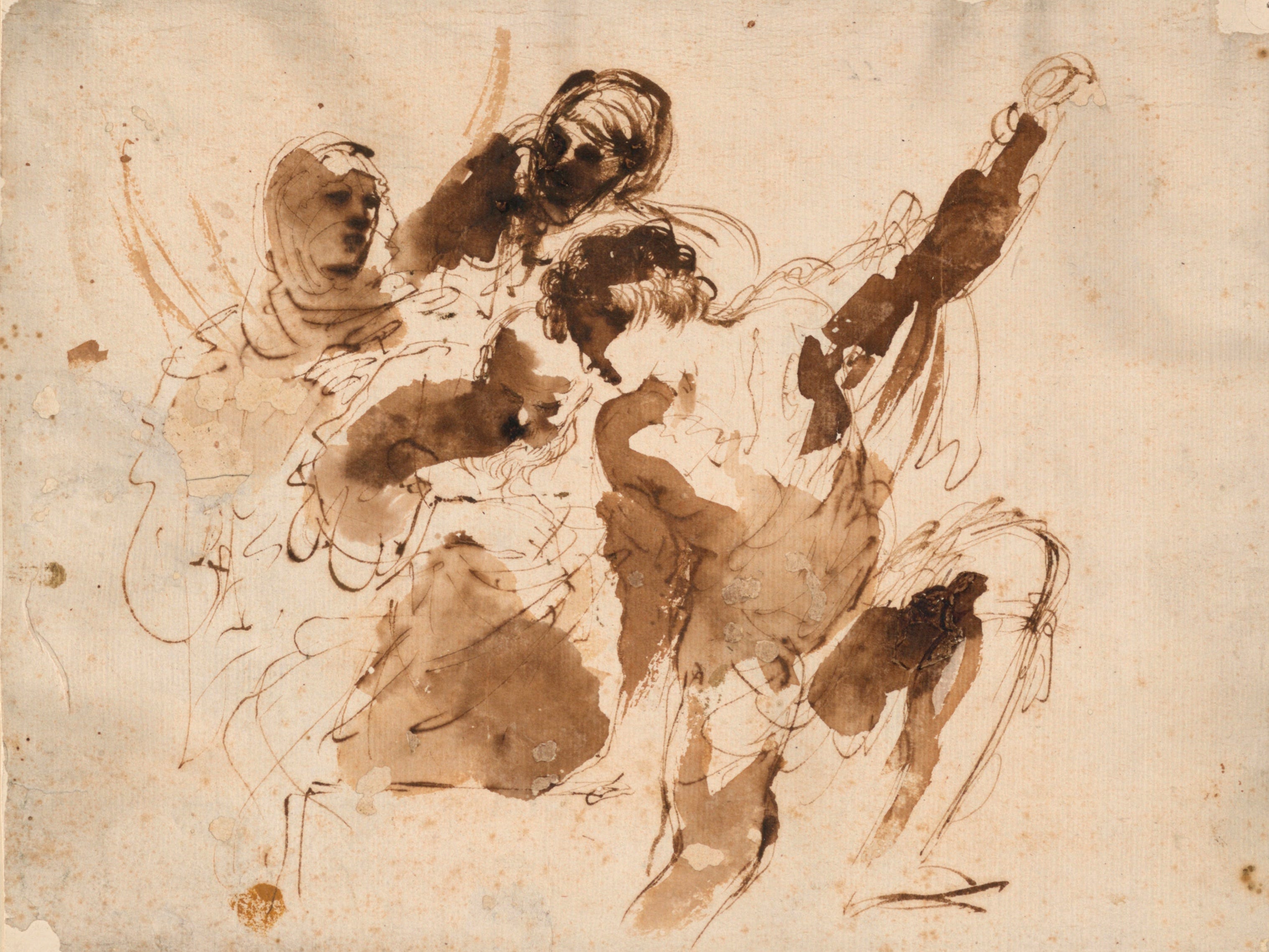
Giovanni Francesco Barbieri (called Guercino), Study of Four Figures, for the Burial of St. Petronilla Altarpiece at St. Peter's, ca. 1623 (public domain)
“Nico” is more of a nickname than a given name in the vague time period depicted
This chapter establishes that the updates to Vessa’s townhouse are completed by the “fifth day” of Nico’s visit, implying that they were finished within one week of Chapter 4, when they were commissioned. This is… a stretch. Adding a few days between the first townhouse visit and the second doesn’t make that much of a difference, but it does feel a tad more plausible.
I am sitting on the edge of feeling terribly sad, but I don’t know if you want me to.