
Chapter Ten
or, Separate Letters, Separate Replies

Indirect light came through the north-facing window, softening the desk and everything on it.
The morning had gone well — letters dispatched, a supplier dispute handled, a revised proposal reviewed and returned with annotations.
Vessa reached for the correspondence stack without looking.
Her hand found nothing.
She looked.
Empty. Of course.
She set her hand flat on the desk.
The first absence she had noticed was the wedding band.
She had worn it for five years and had returned it on the day the civic acknowledgment arrived with matter-of-fact finality. She had not been sentimental about it. She was not sentimental about most things. But for perhaps two weeks afterward she had caught herself registering its absence at odd moments — lifting a teacup, gesturing in conversation, reaching for it with her thumb, which had at some point become a habit she had not noticed until it no longer made sense.
The second absence was the fountain.
The fountain on Villa Casorio’s veranda had chortled and tutted for five years at the edge of her awareness, opinionated, matronly, as reliable as the seasons. She had not thought about it much while she lived there. She thought about it now, with an affection that was as unnecessary as it was real.
The third absence was Varo Bellandi.
She had caught herself twice this week, mid-task, turning toward the corner of the room — once to ask him to draft a reply to the Ferrante representative (in a register that walked the line between cordial and firm, which she had never had to explain to him); once to ask him to pull the original supplier agreement from two years ago (the one with the amended clause in the second appendix, because he would know exactly the one she meant).
Both times, there was only the wall.
Dina knocked at the half-open door.
“The afternoon post, ma’am.”
Vessa had not yet resolved what to be called. My lady was no longer correct, and ma’am had the feel of something improvised by a woman doing her best in an uncertain register, which was accurate and slightly uncomfortable for both of them. Vessa added it to the mental list of things requiring resolution.
“Thank you, Dina,” she said to the housekeeper. “Leave it on the table.”
Three letters. She sorted them by origin without thinking: branch business, a bill from the carpenter (final, settled, satisfying), and — she recognized the hand before she turned it over — Nico.
She opened it.
The letter was characteristically Nico: two pages of large, confident script that covered considerable ground without covering it in any discernible order.
He was well. Mother and Father were well. Dario, who apparently had been whisked back to the capital, was well. He had been to three dinners, two of which he had not wanted to attend, one of which had turned out to contain a very interesting conversation about linen trade routes in the eastern provinces. He had opinions about the linen trade in the eastern provinces. He had enclosed said opinions on a separate sheet. He had heard Father mention the Ferrante contract in three conversations not remotely related to glasswork, which was essentially a standing ovation. He was considering visiting in the next month, possibly two months, he would write ahead this time, probably, he wanted to see how the house was coming on, also he had heard from Beltran who was apparently very absorbed in the fields, which was, Nico felt, very on-brand, and had she seen Beltran recently, and how was Beltran, and also how was she.
The inquiry into her welfare came at the bottom of the second page as though he had nearly forgotten.
She was not fooled.
In her response, she wrote that the house was good. The branch was good. She had attended a meeting between Velleia’s Merchant Guild and the Malendan delegation yesterday, and there were, indeed, opportunities to be had. She would be glad to see him when he came; he should write ahead, two days’ notice at minimum, but the second bedroom was ready (with the curtains he liked) as was the third. She had opinions about the linen trade in the eastern provinces as well and enclosed them separately, since he had started this pattern.
Below that, she wrote: Beltran is well. I had supper with him on Sunday. His new cook is excellent, though not as good as Cook. He told me something very earnest about crop rotation that I found genuinely interesting. He is adjusting. So am I. Write ahead, please. -V
She was about to fold it when she added: P.S. You were right about the house. I thought you should know.
She folded it. Addressed it. Set it with the morning’s post.
Evening had come while she was writing, the light making its concluding arguments, the street going quieter by degrees. She sat for a moment with the finished letter in front of her and the lamp not yet lit and the room suspended between light and shadow.
It was good, the light.
She lit the lamp. Picked up her pen. Got back to work.
Nico’s letter had been sitting in Beltran’s breast pocket for the better part of two days.
It had contained an account of a dinner that had gone wrong in several directions simultaneously; an enclosed pamphlet about a new apple variety from another northern province, included because Nico thought he might find it interesting (he had); opinions about a road in the capital that had been under repair for eleven months; and, near the end, almost buried, set off only by a slight change in the pressure of the pen —
It’s been a month. How are you, actually.
Nico rarely used question marks on the things he most wanted answered, as though punctuating them properly might make them easier to deflect.
Beltran had begun a response this morning, then gone out to the east fields. Half-finished, it still awaited his answer.
The sight of his land in the month of Blooming was one of the better arguments for being alive.
Beltran had not always known this. In the first year he had walked his estate with the expression of a man doing due diligence on something he did not yet understand, taking notes, asking questions, learning to read the land the way you learned to read a person — slowly, by attention, by getting things wrong and then not getting them wrong again. Now he walked because it was his, and because it was good, and because it was beautiful.
Along the field margins and the terrace edges where the ground was thinner, the dye plants were beginning to rise, and beyond them —
The winter wheat.
Knee-high and dense, it moved together with the slight morning wind, the whole field breathing once.
The green of it at this stage was almost unreasonable. Vital and vivid against the pale spring sky.
He had tried, once, to describe it to Vessa, who had listened with the careful attention she gave to things she found interesting but had no framework for, and had then said: so it’s green.
He had laughed for longer than the observation strictly warranted.
The drainage channels ran clear along the field’s lower edge, exactly as they should. Last autumn’s work — three weeks of labor, a considerable investment, a great deal of correspondence written at two in the morning when the question of water management had briefly become the most important thing in his life — was holding. Better than holding; the wheat along the previously waterlogged section was indistinguishable now from the rest of the field. Even growth. Even color. The kind of result that looked, to anyone who hadn’t known those three weeks, as though nothing had ever been wrong.
He had learned, in the six years since the land became his, that satisfaction was a quieter feeling than he had expected — not triumphant, just present and clean.
He walked the field boundary once more, the long way, because the wheat was worth it.
The vineyard was on the south-facing slope above the fields, which was where it had always been, which was where it would always be, which was, as Beltran had come to understand, the primary characteristic of vineyards: they were where they were and had opinions about being moved.
He had come this way because of something he’d noticed three days ago — a faint paling on several of the new shoots near the upper terrace.
Ginevra was already there.
She was perhaps sixty, perhaps older, but looked almost ageless. She had farmed the lease on the upper slope for longer than Beltran had been alive, through two previous owners and now this one.
She did not look up when Beltran approached.
“Rot,” she said.
“I see it.”
“Wasn’t like this three days ago.”
“It was fainter, near the shoots.”
This produced a brief silence that contained, on Ginevra’s part, something that might have been approval.
She was crouching beside the vine, thumb brushing lightly over the surface of a leaf. The growth there was still soft, new — the place where anything that went wrong would show itself first.
“Too much wet,” she said at last. “Hasn’t dried since the last rain.”
Beltran glanced upslope, along the terrace. The rows were clean, but close.
“We can cut it back,” he said.
“We will,” she agreed. “And treat it.”
“With sulfur?”
A considered pause.
“Wouldn’t hurt,” she said. “Works sometimes.”
“The whole upper terrace?”
“All of it. Today, if you can manage it.”
“I’ve already spoken to the men. They’ll start this afternoon, under your direction.”
Ginevra straightened slowly and looked at him with the direct assessment she had turned on him, periodically, over the five years of their acquaintance — checking whether he continued to be worth the trouble of advising.
Then she turned back to the vine, adjusted a shoot with a practiced gesture, and said nothing further, which was Ginevra’s version of good.
Beltran walked the upper terrace himself after she had gone, checking each row, noting the extent of it — less than he had feared, more than he would have liked. This was the kind of thing that could still be turned, if you met it early enough. He hoped this was early enough.
He stood at the top of the terrace, looking down the western slope — the fields below, the villa on its hill in the distance, the city beyond that, small and glittering in the late afternoon light.
The land was good.
He had not expected, six years ago, to feel this about dirt.
The walk back was slow, good-tired.
The southwest sitting room received him as evening settled in — fire lit, chairs waiting, mantle clock ticking steadily.
He sat in his chair. He took Nico’s letter from his pocket and read it once more. Then he unfolded his unfinished response, picked up his pen, and wrote.
He wrote that Vessa had come for supper on Sunday. She had looked like herself — tired and sharp and glad to see him.
Vessa has asked me to attend a textile exposition the Guild is mounting for the delegation — cultural and commercial, she described it as both at once and seemed faintly amused by this. I think I’ll go.
He paused.
The fire made its small adjustments. He watched it for a moment.
You asked how I am, actually. I have been thinking about how to answer that since I received your letter.
The land is good. The work is good. I spend more time in the study, which is not my preference but a necessity nonetheless. Varo tolerates my presence, though you and I know I am no true substitute for your sister’s administrative acumen.
Then: I am, I think, at the beginning of something, though I couldn’t tell you what. I find I’m not inclined to worry about it.
He paused again.
Ask me in another month. The answer may be more interesting.
He signed it. Folded it. Set it with the morning’s correspondence.
The fire had settled into a steady, companionable burn. Outside, the fountain on the veranda had gone quieter, more confidential.
He picked up his book, whose spine was bare and no longer embarrassing.
He read until the fire burned low in the sitting room that was still the best room, a little different now and a little quieter — and his.
Chapter Eleven

The notebook on Adaeze’s worktable had been through three countries and was showing it. The cover was soft from handling — she had developed the habit of running her thumb across it when she was thinking, which she did often enough that a patch of leather had been worn to a shine.
Image
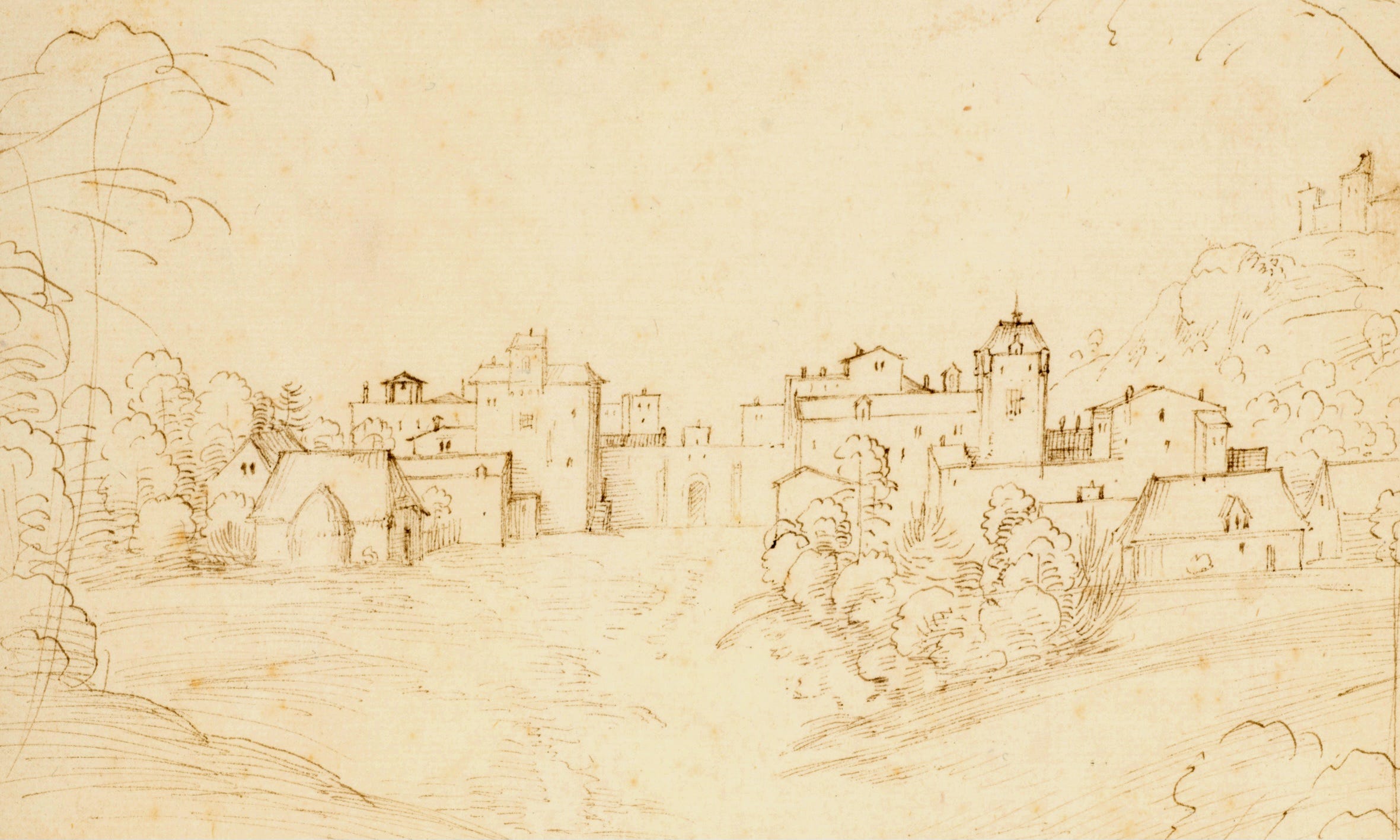
Fra Bartolomeo, A Small Town on the Crest of a Slope, ca. 1504–07 (public domain)
Very exciting, very interesting update: I changed the powdery mildew mentioned in Chapter 10 to a more general “rot.”
Powdery mildew originated in North America and was introduced into Europe in the 19th century.
The setting and time period of The Thing Itself are invented, but immersion matters. In case a viticulture expert ever reads this, I would rather change to “rot” than break it.
See: https://extension.arizona.edu/publication/powdery-mildew-grapes